
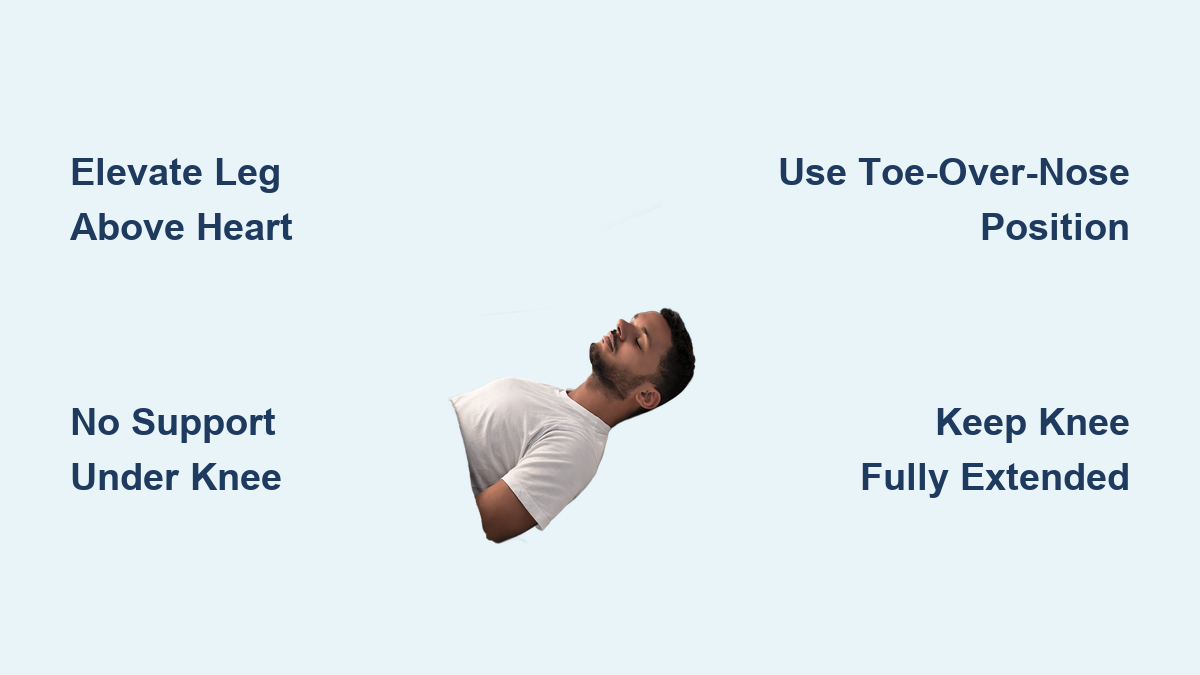
Recovering from total knee replacement brings unexpected challenges, and finding comfortable sleeping positions ranks near the top. Night pain, swelling, and stiffness make rest difficult, leading many patients to search for solutions. A wedge pillow can help reduce swelling and improve circulation, but using it incorrectly may actually slow your recovery. The critical rule that many patients miss: never place any support directly under your knee joint. This guide explains exactly how to position a wedge pillow safely, avoid common mistakes, and support your path to full mobility.
You will learn the correct elevation technique, safe sleeping positions, a simple pillow setup you can create at home, and how to progress your pillow use as healing continues.
Elevate Leg Without Bending Your Knee

Proper elevation is essential for reducing swelling after surgery, but the positioning method matters significantly. Your goal is to elevate your leg above heart level while keeping your knee fully extended.
Keep Knee in Full Extension
Full knee extension is your primary recovery objective after total knee replacement. Even losing five to ten degrees of extension can cause limping, increased joint stress, and long-term discomfort. Gravity-assisted straightening while lying down is one of the most effective passive exercises available.
Placing a wedge or pillow under your knee introduces sustained flexion, which may lead to flexion contracture. This condition makes it difficult or impossible to fully straighten your joint. To prevent this, position support under your calf and foot only, allowing your knee to hang freely in alignment with your thigh.
Medical professionals consistently emphasize this point. One patient recalled that her care team was “adamant about not putting any support under the knee—pillow, wedge, or anything.”
Use Toe-Over-Nose Elevation
The most effective swelling reduction position is called the toe-over-nose method. Elevate your leg so your toes sit higher than your nose. This uses gravity to enhance venous return and lymphatic drainage from the surgical site.
Achieve this by placing your wedge pillow or stacked pillows under the entire length of your leg, from mid-thigh to foot. The incline should be gradual and stable, supporting the leg without bending the knee. This position minimizes edema while promoting passive extension.
Avoid Placing Support Under Your Knee
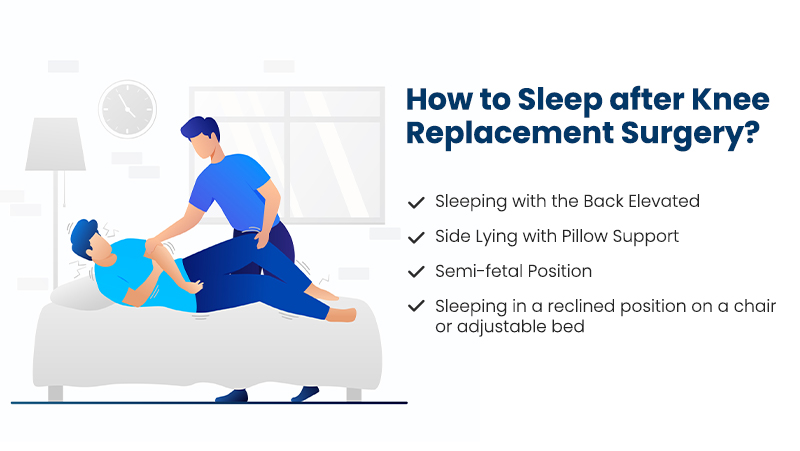
The temptation to place a pillow under your knee for comfort is strong, but this mistake can have lasting consequences for your recovery.
Risks of Flexion Contracture
Putting a wedge pillow under your knee, even briefly, can create cumulative problems. Sustained knee flexion encourages tightening of the hamstrings and posterior capsule. Over time, this leads to flexion contracture.
One patient warned that “the last thing you get back is your extension and you can’t walk without pain if you don’t have your extension back.” This condition may require aggressive physical therapy or additional surgery to correct. The highest risk period is the first two to six weeks post-op when tissues are most susceptible to adaptive shortening.
Skip Divot-Style Knee Pillows
Commercially available divot-style knee pillows feature a central cutout designed to cradle a bent knee. These are not safe after knee replacement. They reinforce a flexed position, increase hamstring tension, and interfere with extension goals.
Even when these pillows feel comfortable at night, their use undermines rehabilitation progress. Choose a flat, supportive wedge or use the T-formation pillow setup described below.
Use T-Formation Pillow Setup

You do not need to purchase an expensive commercial wedge. A simple household pillow arrangement provides excellent support while maintaining proper knee alignment.
Build a Stable Leg Support
Create the T-formation setup using pillows you already have:
Place two long pillows lengthwise under your thigh and calf. This supports the full leg and prevents the knee from dipping. Add a smaller, firm pillow horizontally under your ankle and foot. This elevates the lower leg while preventing plantar flexion.
This setup keeps the knee extended, reduces pressure on the heel, and allows you to adjust height by adding or removing pillows. Physical therapists frequently recommend this configuration for post-operative patients.
Benefits Over Basic Wedges
While flat foam wedges work well, lower-quality models may compress over time or create pressure points on the calf. The T-formation offers customizable support and better stability.
High-density memory foam wedges are excellent alternatives. They resist compression, provide a gradual incline, and support the leg from thigh to foot without bending the knee.
Sleep and Rest in Safe Positions
Your sleeping position significantly impacts recovery. Choosing the wrong position overnight can undo progress made during physical therapy.
Back Sleeping Provides Best Results
The supine position is ideal after knee replacement. Lie flat with your surgical leg straight and elevated on a wedge or T-formation pillows. Keep your toes pointing straight up to prevent external rotation, which strains healing tissues.
This position supports spinal alignment, promotes full knee extension, and minimizes incision pressure. Use this setup every time you rest, not just at night.
Side Sleeping Requires Precautions
You may sleep on your non-operative side once your surgeon clears you. Keep the surgical leg straight and place one to two pillows between your knees and thighs to maintain hip alignment and prevent the leg from crossing midline.
Avoid side sleeping in the first few weeks unless your mobility allows safe positioning. Never bend the surgical knee when turning in bed.
Avoid Stomach Sleeping Early On
Do not sleep on your stomach for at least four to six months post-op. This position places direct pressure on the incision and anterior knee, increasing pain and wound complication risk. Some surgeons allow prone lying later in recovery to stretch the quadriceps, but only with explicit approval.
Correct Leg Alignment During Rest
Proper alignment prevents secondary complications and supports optimal healing.
Prevent External Rotation
Many patients naturally rotate their leg outward when lying on their back. This external rotation leads to malalignment and uneven joint loading.
Place a pillow along the outer side of your leg, from hip to calf, to gently guide your foot into a neutral position. Ensure your toes point toward the ceiling, not toward the opposite leg.
Use Lateral Support as Needed
If your leg tends to roll outward, a rolled towel or small bolster can act as a guide. Secure it lightly with a sheet if needed, but avoid tight binding.
Use Wedge for Safe Recovery Exercises
Your wedge pillow assists with essential rehabilitation exercises when used correctly.
Perform Key PT Exercises on Your Wedge
Use your wedge as a support surface for these essential post-op exercises:
Press your heel into the wedge, tighten your quadriceps, hold five seconds, then relax. This is the quad set exercise. Move your foot up and down for ankle pumps to boost circulation and prevent blood clots. Lift your leg a few inches off the bed while keeping the knee locked straight for partial straight-leg raises. Squeeze your buttocks to activate hip stabilizers with glute sets.
These exercises strengthen muscles, reduce stiffness, and improve joint control.
Try Shore-Arc Quad on Contoured Bolster
If you have achieved near-full extension around zero degrees and your physical therapist approves, a contoured bolster with a flat top can be used for the shore-arc quad exercise. Lie on your back with your knee against the flat surface, then lift your foot to further extend the knee. Use only short durations and stop if you feel strain.
Manage Night Pain and Sleep Disruptions
Night pain is one of the most frustrating aspects of knee replacement recovery. Understanding causes and solutions helps you rest better.
Common Causes of Night Pain
Night pain affects most knee replacement patients. Contributing factors include inadequate pain control due to opioid restrictions, thigh pain from tourniquet use during surgery, swelling that worsens when lying flat, and pre-existing sleep issues amplified by post-op stress.
One patient shared that even the night after surgery she was in too much pain to sleep.
Effective Pain Relief Strategies
Combine medication with non-drug approaches for better results. Take pain medications before bed proactively to maintain comfort through the night. Use ice before sleep, applying a cold pack for fifteen to twenty minutes to reduce inflammation. Never fall asleep with ice directly on your skin.
Try NSAIDs like ibuprofen if your doctor approves. Many patients find them effective for swelling-related pain. Practice sleep hygiene by keeping your room cool, dark, and quiet. Avoid screens and caffeine in the afternoon.
If You Wake Up Stiff
Get up for a short, slow walk with your walker or crutches. This improves circulation and loosens stiff joints. Use dim lighting and clear pathways to prevent falls. Practice deep breathing or visualization to relax and return to sleep.
Progress Pillow Use Over Time
Your pillow needs change as healing progresses. Adjust your setup accordingly.
Early Recovery: First Two Weeks
Focus on maximizing elevation and extension. Use the wedge or T-formation setup every time you rest. Avoid any knee support. Prioritize pain control, swelling reduction, and frequent ankle pumps and quad sets.
Mid Recovery: Weeks Three to Six
As swelling decreases, gradually reduce elevation height. Continue avoiding knee flexion during rest. Begin more active movement as cleared by your surgeon. You may start using a contoured bolster if your extension is near-complete and approved by your physical therapist.
Late Recovery: Week Six and Beyond
Pillow use may no longer be needed once full extension is stable and swelling has resolved. Discontinue elevation when comfortable. Return to normal sleeping positions only with medical approval. If elevation causes discomfort, lower the height and adjust gradually.
Follow Professional Guidelines
Always coordinate pillow use with your surgical team. Their specific recommendations override general guidelines.
Surgeon and Physical Therapist Advice
Medical professionals emphasize avoiding any support under the knee, lying flat on your stomach when cleared to stretch quadriceps, moving frequently even when painful, attending all physical therapy sessions, and using CPM machines if prescribed.
Pain Management Considerations
Due to opioid restrictions, many patients rely on combination therapy such as Tylenol plus ibuprofen if safe for you. NSAIDs are effective for inflammation and may reduce opioid dependence. Always consult your doctor before starting new medications.
Frequently Asked Questions About Wedge Pillow Use After Knee Replacement
Can I use a regular pillow under my knee for comfort?
No. Placing any support directly under your knee joint, including regular pillows, risks causing flexion contracture. This condition makes it difficult to fully straighten your knee and can delay your recovery. Always place pillows or wedges under your calf and foot only.
How high should I elevate my leg after knee replacement?
Elevate your leg so your toes are higher than your nose. This toe-over-nose position uses gravity to reduce swelling effectively. Your foot should be above heart level for optimal fluid drainage.
When can I stop using a wedge pillow after surgery?
Most patients transition away from pillow use between weeks four and eight, depending on swelling reduction and extension achievement. Continue using the wedge until your surgeon or physical therapist approves discontinuation. Do not stop simply because the position becomes uncomfortable.
Can I use a contoured knee bolster after knee replacement?
Contoured bolsters with flat top sections may be used after approximately two weeks, but only when near-full extension around zero degrees has been achieved. Use requires clearance from your surgeon or physical therapist and should be limited to short durations.
What is the T-formation pillow setup?
The T-formation uses household pillows arranged to support your leg without bending your knee. Place two long pillows lengthwise under your thigh and calf, then add a smaller firm pillow horizontally under your ankle and foot. This configuration keeps your knee extended while providing stable elevation.
Is it safe to sleep on my non-operative side after knee replacement?
Yes, sleeping on your non-operative side is permitted once cleared by your surgeon. Keep your surgical leg straight and place one to two pillows between your knees and thighs to maintain proper hip alignment. Avoid this position in the first few weeks unless your mobility allows safe positioning.
Key Takeaways for Safe Wedge Pillow Use After Knee Replacement
A wedge pillow can significantly aid your recovery when used correctly, but the positioning method determines whether it helps or harms your progress. The most critical rule is supporting your leg under the calf and foot while keeping your knee fully extended and unsupported. Never place any pillow, wedge, or bolster directly beneath your knee joint, as this promotes flexion contracture and compromises your ability to walk without pain.
The toe-over-nose elevation technique effectively reduces swelling by using gravity to improve circulation. Whether you use a commercial memory foam wedge or create a T-formation with household pillows, the goal remains the same: elevate the entire leg while maintaining full knee extension. Sleep on your back whenever possible, and only transition to side sleeping on your non-operative side with proper pillow support between your knees.
Progress your pillow use gradually as healing occurs, typically reducing elevation height by weeks three through six and discontinuing use entirely by week six or eight if extension is stable. Combine proper positioning with prescribed exercises, proactive pain management, and good sleep hygiene for the best recovery outcomes. Always consult your surgeon or physical therapist before making changes to your positioning routine, and report any signs of circulation problems or increased pain immediately.